Winterizing Your Castle Rock Irrigation System and Backflow Preventer Before First Freeze
Castle Rock Water requires annual backflow preventer testing for properties with irrigation systems, and Castle Rock's first hard freeze arrives as early as mid-October. Failing to winterize the backflow assembly before that freeze can crack the body and turn a $75 test into a $300 to $450 replacement. This guide covers the sequence and timing for Castle Rock irrigation winterization.
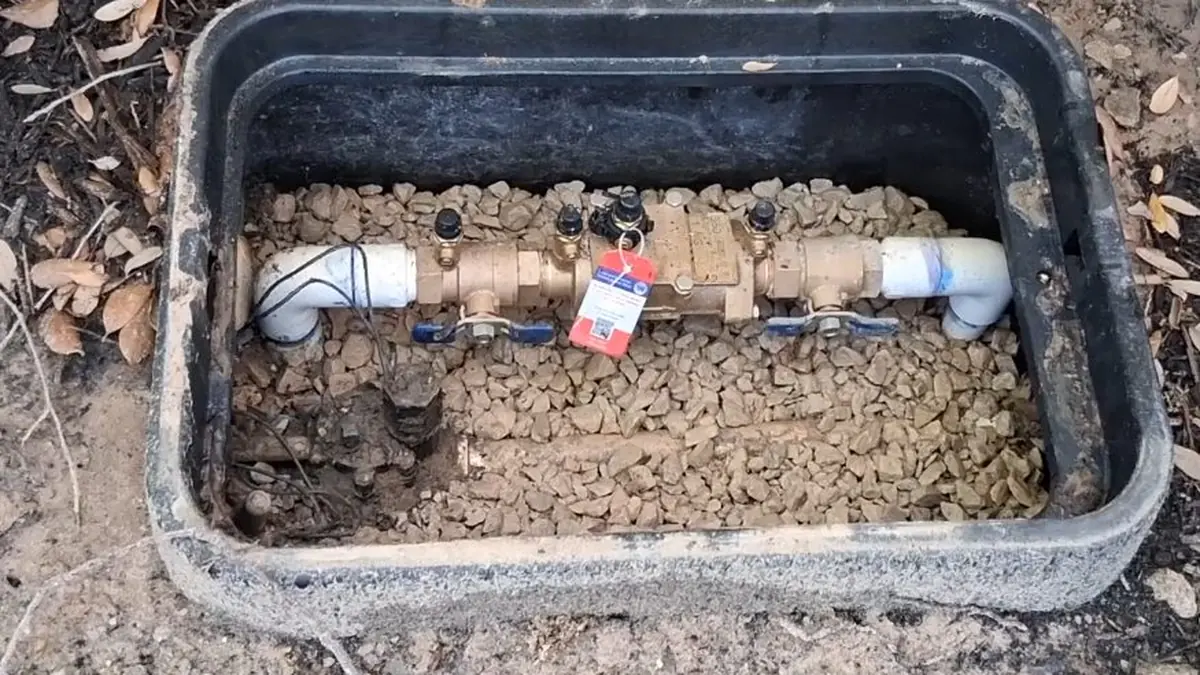
The Castle Rock backflow testing and winterization calendar
Castle Rock Water's annual backflow testing window opens in spring when irrigation systems come back online, with the test report deadline typically falling in June or July depending on the current year's program schedule. Castle Rock Water sends annual notices to properties with registered backflow assemblies specifying the deadline for that year's report submission.
Winterization happens on the other end of the season: before the first hard freeze in fall. Castle Rock's first freeze at or below 28°F typically arrives in mid-October, though it can come earlier in years with an early winter onset on the Palmer Divide. The backflow assembly must be properly shut off and drained before that freeze to protect it from freeze damage. The sequence is: annual test in spring, irrigation season through summer, winterization in early-to-mid October before the first hard freeze.
Understanding your backflow assembly type
Most Castle Rock residential irrigation systems use a pressure vacuum breaker (PVB) as the backflow prevention assembly. The PVB is typically installed above the highest irrigation head in the system, usually on the exterior of the house on the supply line between the house shut-off and the irrigation controller connection. It has a bonnet with an air inlet valve on top and two shut-off handles, one on the inlet and one on the outlet side.
The PVB must be physically above the highest irrigation head in the system to function as backflow prevention. It also must not be buried or installed in a vault below grade. If your irrigation system has been modified and the PVB is no longer the highest point in the system, the assembly needs to be relocated or the system reconfigured to maintain compliance with Castle Rock Water requirements.
Some older Castle Rock installations or properties with more complex water use patterns may have a double check valve assembly (DCVA) or a reduced pressure zone assembly (RPZA). These assemblies have different winterization steps and different testing requirements. If you are uncertain which assembly type you have, Castle Rock Plumbing Pros can identify it during the annual test visit.
Winterizing a PVB step by step
The PVB winterization sequence for a Castle Rock irrigation system is straightforward. First, close the main irrigation water supply valve at the house. This is typically a ball valve on the supply line inside the garage or utility room, before the line exits to the irrigation system. Second, run each irrigation zone manually for 30 to 60 seconds to bleed pressure and water from the zone lines. Third, at the PVB assembly itself, close both shut-off handles (rotate them perpendicular to the pipe direction). Fourth, open the test ports or relief valves between the two shut-offs to allow any trapped water to drain. If the PVB has a bonneted air inlet, that can remain in the closed or open position depending on the assembly design.
Some irrigation systems require a blowout with an air compressor to fully evacuate water from lateral lines, particularly in systems with spray heads that do not drain by gravity. If your system has heads in low areas or the grade does not allow gravity drainage, a compressed air blowout is the appropriate winterization method. This is typically done by an irrigation contractor, not a plumber, but Castle Rock Plumbing Pros can winterize the backflow assembly as part of the fall service visit regardless of who handles the irrigation lines themselves.
What happens if the PVB freezes before winterization
The PVB body contains water between the two shut-off handles when the system is in service. If that water freezes, the expansion cracks the plastic or brass bonnet, the body casting, or both. A cracked PVB fails the annual test and must be replaced before the irrigation system can be put back into service the following spring. The replacement cost ($200 to $450 installed) is avoidable with a timely fall winterization. Castle Rock Plumbing Pros sees cracked PVB assemblies every spring that were damaged the previous fall by freeze events that arrived before the homeowner winterized the system.
Annual backflow testing and report filing
The annual test must be performed by a certified backflow tester. Castle Rock Plumbing Pros employs certified testers and files the test report directly with Castle Rock Water as part of the service visit. The test typically takes 20 to 30 minutes for a standard residential PVB. If the assembly fails the test, repair or replacement is required before the system can be returned to service and before the test can be filed as a pass. Castle Rock Plumbing Pros performs both testing and any necessary repair or replacement in a single service visit when possible.
Annual backflow testing and fall winterization in Castle Rock
Castle Rock Plumbing Pros provides certified backflow testing with same-day report filing to Castle Rock Water, plus fall winterization service. (720) 698-9364