Why Castle Rock has elevated slab leak rates
A slab leak is a failure in a water supply or drain line buried in or beneath a concrete slab foundation. In most housing markets, slab leaks are relatively uncommon. In Castle Rock and the surrounding Douglas County communities, the combination of soil geology, construction era, and water chemistry creates a higher-than-average incidence.
The Pierre Shale and Niobrara Formation clay soils that underlie most of Douglas County expand when saturated and contract when dry. The Front Range climate cycles between wet springs and dry summers, putting those soils through significant volume changes over the course of a year. A slab-on-grade foundation built over these soils experiences slow, cyclical movement. The copper water lines embedded in that concrete, particularly at fittings, bends, and changes in direction, absorb the mechanical stress of that movement over time. After 15 to 25 years, the fatigue accumulates.
Castle Rock's housing boom ran from roughly 1990 through 2015, producing tens of thousands of homes in The Meadows, Founders Village, Crystal Valley Ranch, Cobblestone Ranch, Castlewood Ranch, and the adjacent neighborhoods. Many of those homes were built on slab foundations with copper supply lines. Those homes are now entering or passing through the age window where soil-stress-induced slab leaks become more common.
Castle Rock Water's moderate-hard supply (120 to 180 parts per million) contributes an additional factor: the water chemistry slightly accelerates corrosion at copper pipe joints compared to softer water areas, particularly in hot-water lines that run at higher temperatures.
Warning signs of a slab leak in Castle Rock
Slab leaks often run for weeks or months before they are identified, because the water is released below the floor and works its way up or outward gradually rather than producing an obvious visible leak. Knowing the warning signs cuts the time between onset and repair.
Warm spots on the floor. A hot-water line leaking under a slab releases heat upward through the concrete. A section of floor that feels warm to the touch in an area with no radiant heating below it is a reliable early indicator of a hot-water slab leak.
Water meter movement when nothing is running. Turning off all fixtures and appliances in the home, then watching the water meter for 15 to 20 minutes confirms or rules out a running leak. Any meter movement with everything off indicates an active underground leak somewhere in the system.
Rising water bills without explanation. A hot-water slab leak that runs at a low rate can add $50 to $200 or more per month to a Castle Rock Water bill, depending on the size of the failure and how long it goes unaddressed.
Mold or mildew odor near floor level. Water wicking up through concrete and into flooring materials or base-level drywall creates conditions for mold growth. A persistent musty smell at floor level without an obvious surface water source warrants investigation.
Unexplained low water pressure or constant water heater cycling. A hot-water slab leak effectively creates an open-loop demand on the hot water system. The water heater runs near continuously trying to maintain temperature and pressure in a line that is not holding either.
How slab leak detection works
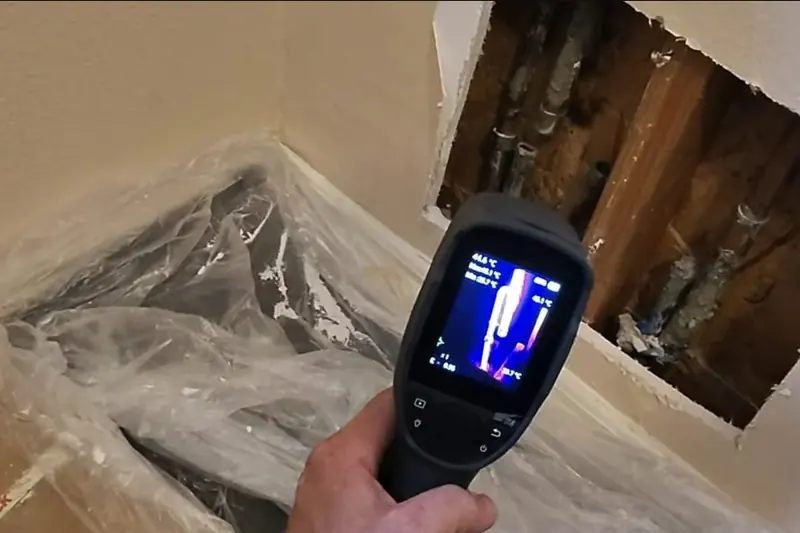
Non-destructive location is always the starting point. Cutting into a slab without knowing where the leak is guarantees unnecessary damage and cost. The detection process uses pressure testing to identify which line is failing, acoustic listening equipment to isolate the leak sound to a specific floor zone, and in some cases electronic pipe location to map the pipe routing before any concrete is cut.
Access to all interior fixtures is required during the diagnostic visit. The water heater should be shut off at least 30 minutes before arrival for hot-water line diagnostics so the system can equalize. Detection visits typically take 1 to 3 hours depending on the home's floor plan complexity and the clarity of the acoustic signal.
Slab leak repair options in Castle Rock
Targeted slab opening and direct repair. For a single well-localized failure point, opening the concrete at the identified location, making the pipe repair, and patching the concrete is often the most cost-effective approach. This method works best when the pipe is in accessible floor area, the concrete is not heavily reinforced in the repair zone, and the surrounding pipe section is otherwise in good condition.
Epoxy pipe lining. A structural epoxy liner is installed inside the damaged pipe segment without cutting concrete. The liner cures in place and creates a new sealed pipe surface inside the existing copper run. This method avoids concrete work entirely but requires the pipe interior to be cleanable and the run to have accessible endpoints. It is well-suited for straight or gently curved runs of supply pipe.
Pipe rerouting above the slab. For older copper lines with multiple failure points, extensive corrosion, or in locations that are difficult to access through the slab, rerouting the supply line above the slab through walls, ceilings, or the basement avoids the slab entirely. This approach eliminates the slab-related failure risk for the rerouted line but involves more carpentry and drywall work.
Slab leak detection and repair costs in Castle Rock
| Service | Typical Range |
|---|---|
| Detection visit (acoustic and pressure) | $250 to $500 |
| Targeted slab opening and direct repair | $800 to $2,500 |
| Epoxy pipe lining (per segment) | $1,500 to $4,000 |
| Pipe rerouting above slab | $2,000 to $5,500+ |
| Slab patch after access (concrete) | $200 to $600 |
Prices are approximate ranges for Castle Rock and Douglas County residential work. Final scope depends on pipe location, repair method, and floor covering. Written estimate provided before any concrete is cut.
Frequently asked questions: slab leaks in Castle Rock
Detection using acoustic or electronic equipment runs $250 to $500. Repair costs depend on the method: targeted concrete opening and direct pipe repair typically runs $800 to $2,500; epoxy pipe lining without cutting concrete runs $1,500 to $4,000 for a segment; pipe rerouting through walls or the basement can run $2,000 to $5,000 or more for a complex layout. Insurance coverage varies by policy and the cause of the failure.
Most slab leak detection visits take 1 to 3 hours for a standard residential foundation. The process involves pressure testing to confirm and locate the leak zone, followed by acoustic or electronic scanning to pinpoint the exact pipe position. Access to all fixtures is required during testing. If the leak is in a hot-water line, shutting off the water heater for 30 minutes before the visit improves detection accuracy.
Many standard homeowner's policies cover sudden and accidental water damage including the cost of accessing the pipe (breaking through concrete) but not always the pipe repair itself. Gradual leaks that developed slowly over time are frequently excluded. Review your policy's water damage section carefully and document the damage fully before work begins.
A running hot-water slab leak drives your water bill up continuously. Over time, water saturating the soil under the slab in Castle Rock's Pierre Shale clay can cause differential settling and foundation cracking. Mold can develop inside the concrete and sub-floor materials. A small slab leak that costs $800 to repair can become a foundation and mold remediation problem costing ten to twenty times more if left untreated for years.
The Meadows, Crystal Valley Ranch, Castlewood Ranch, and Cobblestone Ranch account for a disproportionate share of slab leak service calls because they were built primarily from the mid-1990s through the 2010s on slab-on-grade foundations with copper water lines. Homes in that age range (15 to 30 years) are in the window where soil movement stress, water chemistry effects, and pipe joint fatigue tend to produce failures.